
InMode (INMD): Low-risk Take-Private Opportunity *Exited*
Why the risk / reward set-up is attractive.

Not investment advice: First, read my full disclaimer here.
Date: February 2, 2026 // Current Price: $16.62
As I disclosed to my paid subscribers on Friday, I’ve added to my position in InMode (INMD). Recently, there has been a flurry of take-private activity I think provides the catalyst to make this an attractive entry point.
Why this situation matters now
Last week, InMode became the center of two overlapping “in-play” storylines: (1) a reported ~$1.1 billion take-private discussion attributed to Israeli outlet Calcalist and (2) a public proposal from Steel Partners to buy 51% of the company at $18.00 per share.
This became more interesting over the weekend, with a seemingly desperate plea by Moshe Mizrahy (founder / CEO) to ‘keep InMode in Israel.’ You have to give him credit. He is always ready with a flurry of excuses for why InMode’s recent operating performance has been so poor. His quotes are quite meandering and should serve as a great advertisement for PE funds to join the bidding.
Here is the article punch line: There are three bidders for InMode. Two bidders in the official process led by Bank of America for selling the company outright are private equity firm Centroid of South Korea, and a group of Israeli and US investors that includes Mizrahy himself.
These two are offering $1-1.1 billion for the company ($16-17 per share). The deadline for final bids is in mid-February.
My wager is there could be additional bidders. I’ll outline why below.
Company overview: what InMode sells and how it makes money
InMode primarily designs, develops, manufactures, and sells non-invasive and minimally invasive aesthetic medical devices. Its primary product is a radio frequency powered skin tightening device called Morpheus8.
Commercially, InMode’s economics are driven by a “platform + handpiece + disposable” model:
Systems are sold as platforms with handpieces/applicators.
Many handpieces or tips are single-use consumables that must be replaced per treatment, creating recurring revenue.
InMode derives most revenue from selling platforms and non-consumable handpieces, with an additional recurring component from consumables (e.g. single-use tip heads) and extended warranties.
Installed base matters because more systems in the field typically expand consumables/service pull-through; InMode reported ~27,090 platforms installed globally as of Dec. 31, 2024.
In short: InMode is not a pure “one-and-done capital equipment” story. It has an annuity-like attachment layer, but its growth still depends heavily on new system placements into med spas and physician practices which is tied more to discretionary spend cycles.
Bad Execution: the Sofwave problem
The macro backdrop: aesthetics demand is resilient, but a competitor has taken share
Sofwave is selling into the same customer wallet (aesthetic practices / med spas), but with a different modality. Sofwave markets SUPERB™ (“Synchronous Ultrasound Parallel Beam”) as non-invasive ultrasound technology that is FDA-cleared for facial lines/wrinkles and multiple lifting/laxity indications. Sofwave was savvy in their requirement for customers to buy each pulse used in the treatment of their clients. This creates the ability to better control their IP by boxing out cheap consumables and provides incremental 100% margins.
On procedure demand, global aesthetic volumes remain large. The reported “close to 38 million” aesthetic procedures in 2024, with total surgical and non-surgical procedures up sharply versus 2020. This reality is in stark contrast to the constant fumbles and excuses being made by InMode leadership.
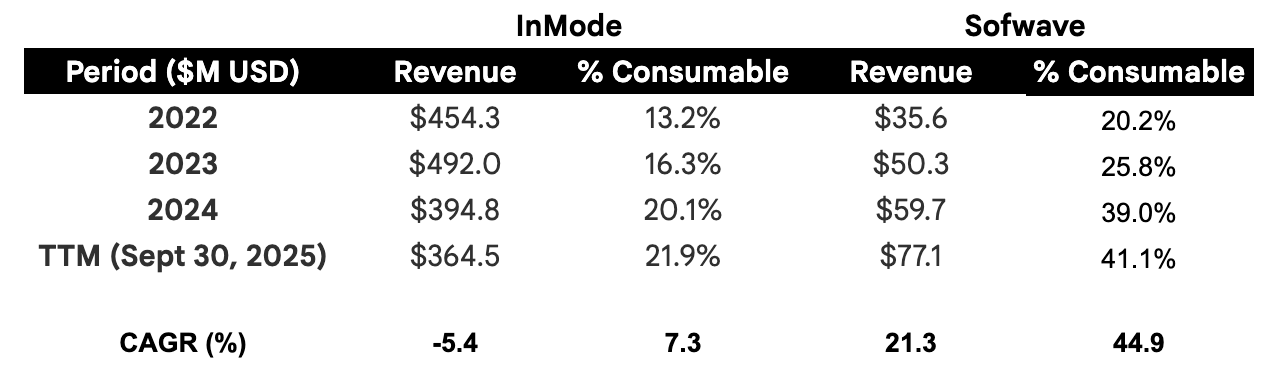
More concerning is the variance in service and consumable revenue generated by the two companies. This reflects a better business model as it pertains to Sofwave in addition to the high usage/utilization of their products.
In Summary: InMode still has a deep catalog and a large installed base. But in a market where “needle-free” and low-downtime value proposition is winning, Sofwave’s modality and growth profile show the importance of refreshed product appeal.
Financial profile: why Private Equity should love this opportunity
Impeccable balance sheet, incredible margins and bloated SG&A
The uncomfortable truth for Moshe: InMode is unusually “LBO-shaped.”
(1) It has a large cash position.
(2) It has historically generated substantial profitability even after the revenue decline.
(3) It has clear cost-lever opportunities in sales & marketing.
Say the current offer is $1.1B, which would imply a stock price of $17.40 (based on 63.2M shares outstanding).
Let’s break it down:
(1) InMode has net cash of $532M at the end of Q3 and probably made ~$30M since. Back that out and the price is $538M. So the question becomes - how you will fund this?
(2) Trailing twelve-month EBITDA is $88.1M. If you funded the whole ex-cash purchase price with debt, that’s 6.1x turns. Each additional turn adds $1.39 to the share price.
(3) Here is where things get interesting: there is probably a lot of fat in SG&A. Any discerning buyer is coming in and giving this a good, hard look. Since 2021, SG&A has gone from 35% to 51% of sales, totaling $187M per year. If they get back to 35%, that would be $60M in annual savings. If that is the case, they’ll be modeling in $148.1M in EBITDA, placing EV/EBITDA closer to 3.6x.
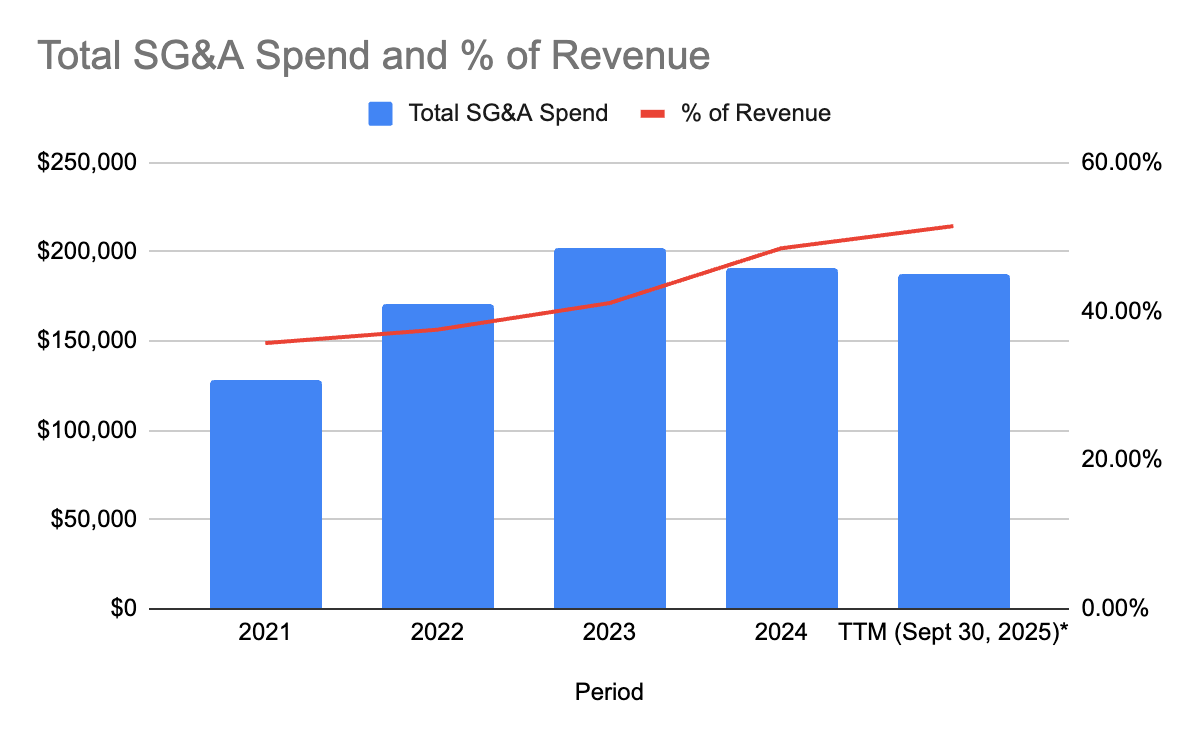
Any way you cut it, a buyer can come in and buy a mismanaged asset for a very low valuation ex-cash.
The amount of equity needed to fund a purchase is not exorbitant and can likely be repaid to shareholders in a very reasonable timeframe.
In Summary
It is time for new ownership and leadership at InMode. For years, it has been an unending stream of excuses that not only show a lack of execution, but a lack of ownership and responsibility. This has eroded confidence in business and provides a great opportunity for a new vision to assume the reins.
My perspective and hope is that a savvy PE buyer will step up and seize the opportunity by offering a premium to the $1-$1.1B low-ball offer that has been rumored from management.
What’s the Downside? My expectation is that $1B is the floor. This is ~5% lower than current prices and would imply ~$15.80 a share. If a deal were not consummated, it is likely the price would retreat under $14. However, the net cash value of the business being ~50% of market cap provides very solid support.
Do your own due diligence. Any investment has the potential to fall to $0. I own shares in several of the companies discussed. Therefore, I am biased toward their success. All information should be double-checked, as it could be wrong. I could change my positions at any time. See my full disclaimer here.
Didn’t it feel like a manipulation when the board published that shitty guidance for 2026 dropping the prices, while it seems they were already preparing an offer to buy out? The stock was at 15,5$ and going up before the guidance, and after, the price dropped to 13.8$. Now they want to offer 16-17$ (25% premium according to them) but it’s more like a 5-10% on the price it was before the publication of the guidance. Why did they publish that shit if they were also looking for external buyers anyway? It feels to me they did it to ensure themselves a good price. What do you think?