
What to Expect from Underlying Value
Price is what you pay, value is what you get.

Not investment advice: First, read my full disclaimer here.
Thank you for being here. Substack is crowded, and I appreciate you taking the time to visit my corner of the platform. This introduction is meant to give you more information about what you can expect from my blog, Underlying Value.
What is Underlying Value?
This blog documents my global search for the most undervalued public investments.
This search tends to lead me to small, obscure, and illiquid investments with catalysts I don’t believe the market has accurately priced in.
I do not care about likes or clicks. I care about compounding the relatively small amount of family capital we have in a sustainable, long-term, process-oriented way.
Here is a rough sequence of events that brought me here:
Q1 ‘25: Exited the business my wife and I bought through a search fund and operated for five years.
April: Sought to answer the question: Are there mispriced investments in the public markets? With all the froth, I was skeptical. However, I walked away encouraged, especially after attending the Planet MicroCap Conference in Vegas.
May to November: Spent six months finding and investing in the best companies I could identify.
November to Present: Began writing the investment theses for our holdings, which turned into this blog.
What You Can Expect
In 2026, I’m going to write about the best public investments I’ve found. These are the opportunities my family and I are currently invested in. I’ve put in work by speaking with management, connecting with fellow investors, and poring over all the information I can gather to inform my decision-making.
Founding Members will receive access at least two business days before each post is released to other paid subscribers. All paid members will have access to a chat forum where I’ll share interesting investment thoughts and findings. I’m a big fan of borrowing from others and will share accordingly.
These are ideas I’m currently writing about. They are deep-value opportunities. They’re also all small-caps (sub-$50M market cap), domiciled outside the United States, and illiquid.
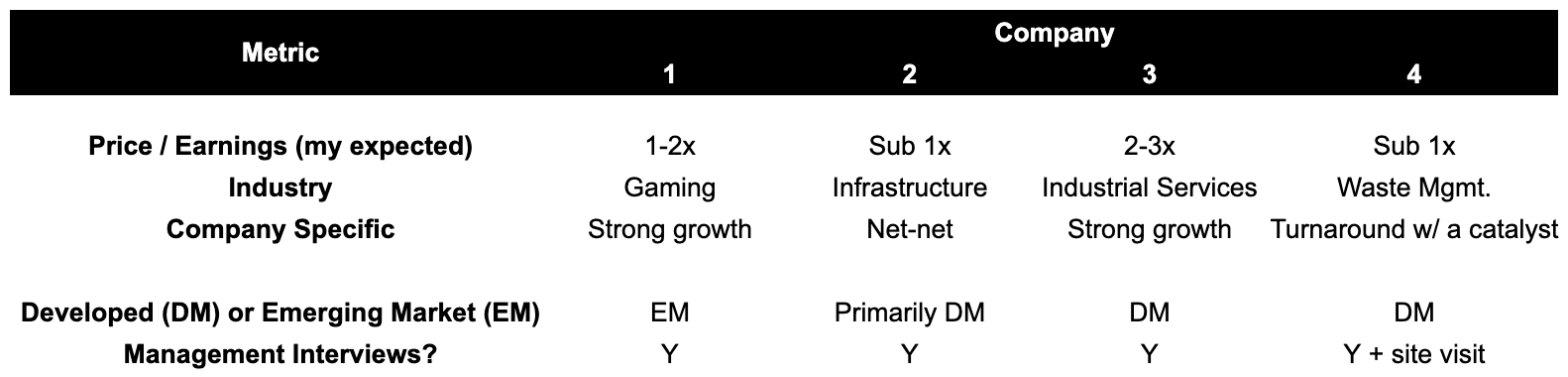
As you’d expect for opportunities this inexpensive, I’ve seen zero coverage on companies #1-3 and limited coverage on #4.
My Investment Process (Investment Identification)
The goal of Underlying Value is to deliver actionable research and analysis to my subscribers. Success or failure of this objective will be clear based on the returns of the high-conviction write-ups I make (not all posts are created equal). Several of these have already been posted here, here, and here.
The internet has changed how public-market investing works. Access to information is no longer gated by large institutions or centralized research departments. Corporate disclosures, earnings calls, and industry data are widely available in real time. At the same time, many of the world’s most respected investors openly share their thinking through quarterly letters, conference talks, Substack posts, and platforms like X.
The advantage today does not come from access to information, but from judgment. Investors who can consistently identify what matters, ignore what does not, and act decisively when opportunities arise are the ones most likely to outperform.
This process can be meaningfully improved through the disciplined use of artificial intelligence. AI is a tool for leverage - not a substitute for thinking. It is only as effective as the questions asked and the rigor applied in validating its output. Used carelessly, it adds noise. Used thoughtfully, it accelerates research, broadens perspective, and improves efficiency.
For an investor operating without a large team of research analysts, AI can function as a force multiplier. When paired with skepticism, domain knowledge, and independent verification, it becomes a practical way to move faster without sacrificing quality.
What are the steps in my process? Each of these serves as a sequential filter before investing in an opportunity:
Idea Sourcing
I source ideas through two primary channels:
Ongoing review of work published by proven investors globally
Independent, bottom-up analysis using financial screens and primary research
This ensures exposure to both differentiated thinking and under-followed opportunities.
At the top of the funnel, I like to load in diversity. Diversity of geography, culture, company size, industry, risk, and investment types (growth, value, special situations).
Fundamental and Industry Analysis
For ideas that pass the initial screen, I conduct a detailed review of company fundamentals, competitive dynamics, industry structure, and current market positioning. This step is focused on understanding how the business actually makes money, what drives returns, and where the market may be mispricing risk or opportunity.
Management Engagement
When feasible, I speak with management armed with the right questions to gain a clearer perspective on the opportunity. This is a key aspect of where I add value after my years of operating, by distilling a potentially attractive investment into its core value drivers and diving deep to accumulate richer context.
Decision and Documentation
I decide whether to invest, with a thesis written to articulate my expectations. If not investment-caliber, it gets discarded or slotted for follow-up / monitoring.
The best opportunities are those that have a specific, un(der)appreciated catalyst. This could be in the form of new management, divestiture of a money-losing division, new business, etc. Especially when you are researching small-cap investments, the market tends to be less efficient, and you can find gaps between perceived and intrinsic value. There are also opportunities I find during my process that I catalog as being potential investments if something specific happens. For example, if certain regulations change or the geopolitical environment shifts. This can serve as the catalyst needed to unlock value for certain companies and can be rewarding for those prepared and willing to invest before the broader market catches on.
Investing is a hard game. There is good reason for the proliferation of passive investment strategies. However, for those who are industrious and willing to do the work, I believe there continues to be an opportunity to sustainably and consistently outperform broader indices.
I wish you a happy and healthy 2026, and hope we have the opportunity to partner on some exciting investments.
Onward and upward,
Andrew Pogue
Andrew.R.Pogue@gmail.com
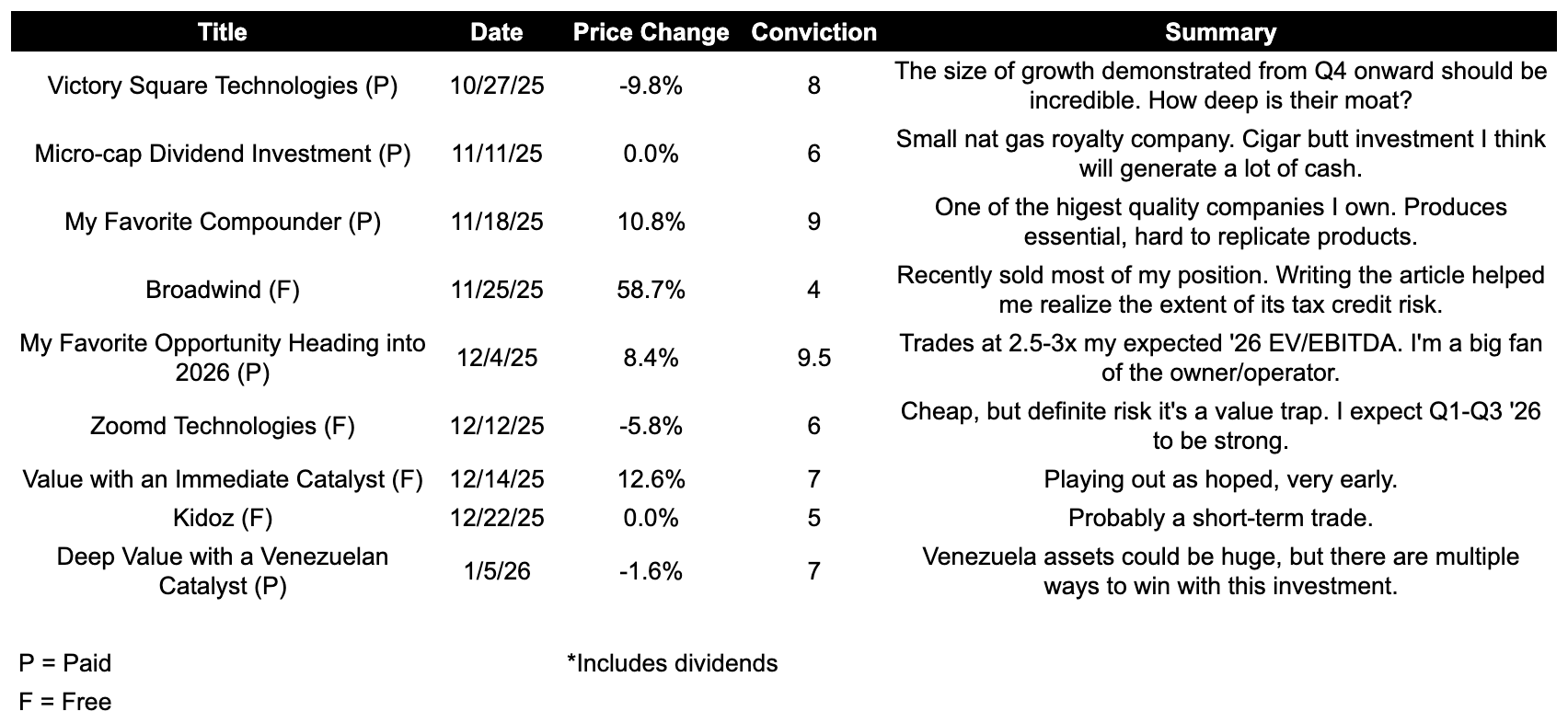
Summary of Profiles so far:
This is not investment advice. Do your own due diligence. Any investment has the potential to fall to $0. All information should be double-checked, as it could be wrong. I could sell my position at any time.